How to Fit a Hybrid Bike in 7 Easy Steps
Are you tired of feeling uncomfortable or awkward on your hybrid bike? You’re not alone—many riders struggle to find that perfect fit that makes every ride enjoyable.
Luckily, fitting your bike properly can make a huge difference in comfort and performance.
To fit your hybrid bike in 7 easy steps, start by evaluating your current riding position, focusing on saddle height and reach.
Choose the right frame size by measuring your inseam and testing different options.
Adjust your saddle’s height and fore-aft position for comfort and efficiency.
Fine-tune handlebar reach and angle for control, then set the stem length and angle.
Finally, test your fit and make small tweaks to enjoy a comfortable, safe ride.
Keep going to learn more details on each step.
Key Takeaways
- Measure your current riding position and inseam to figure out the right frame size and saddle height.
- Adjust the saddle height so your leg has a slight bend at the bottom of the pedal stroke.
- Move the saddle forward or backward to find a comfortable position that allows for good pedaling efficiency.
- Set the handlebar reach and angle so your arms are relaxed and you have a clear view of the road ahead.
- Take the bike for a test ride to see how everything feels.
- Make small tweaks to the saddle and handlebar positions as needed for comfort and control.
- Check that the bike is level, tires are properly inflated, and make any final adjustments for the best fit.
Why Proper Bike Fit Matters for Hybrid Riders
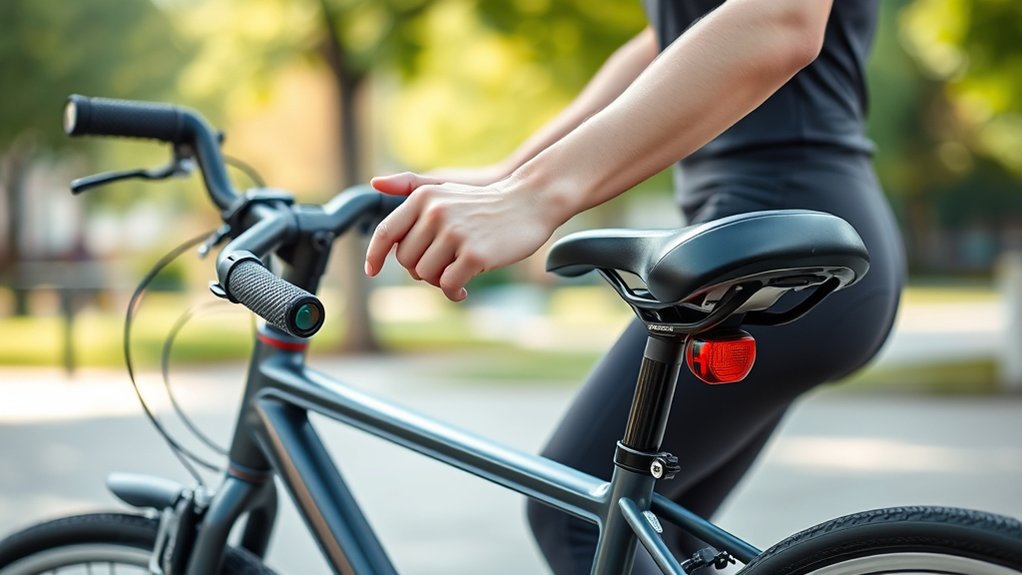
A proper bike fit is key for hybrid riders because it impacts comfort, efficiency, and safety. When your bike fits well, you’re less likely to experience strain, soreness, or injuries during your rides.
A good fit lets you pedal smoothly without overextending or feeling cramped, which makes riding easier and more efficient. It also helps you stay in control and stable, especially on different terrains.
An ill-fitting bike can cause discomfort that might make you want to cut your rides short and reduce your enjoyment. Plus, it can lead to unnecessary fatigue and issues like numbness or joint pain.
Investing in a proper bike fit means you can ride more comfortably, confidently, and safely. Ultimately, it makes every ride more enjoyable and sustainable over time.
How to Measure Your Current Riding Position
To make sure your bike fits you well, start by measuring your current riding position. First, sit on your bike in your usual riding stance.
Begin by sitting comfortably on your bike to assess your ideal riding position.
Use a tape measure or ruler to note the distance from the saddle to the handlebars. Keep your hands on the grips and your feet on the pedals as you do this.
Record the vertical distance from the saddle to the handlebars, and measure the reach from the saddle’s center to the brake levers or handlebars. Pay attention to your posture—are you stretched out or too cramped?
Also, note your saddle height and angle. These measurements help you understand your comfort zone and guide you in choosing a frame that matches your riding style.
Accurate measurements ensure a more comfortable, efficient fit, making your rides better all around.
Choosing the Right Frame Size for Your Hybrid Bike
Choosing the right frame size is key for comfort and efficiency on your hybrid bike. To find the best fit, start by measuring your inseam. Stand against a wall with your shoes on and mark the top of your inner thigh.
Multiply this measurement by 0.67 to estimate your ideal frame size in centimeters. You can also check the bike manufacturer’s sizing chart, which recommends sizes based on your height and inseam.
Remember, a frame that’s too small or too large can cause discomfort and make controlling the bike harder. If possible, test ride different sizes to see how each handles.
Getting the right frame size helps you maintain a comfortable riding posture, reduces fatigue, and makes your overall cycling experience much better.
Adjusting Your Saddle Height for Comfort and Power
To ride comfortably and efficiently, you need to set your saddle height correctly. One simple way is the heel method—sit on your bike and keep your heel on the pedal at the bottom of the pedal stroke.
Your leg should be almost straight when your heel is on the pedal. Adjust the saddle until you find that ideal height for both comfort and power.
Finding Proper Saddle Height
Finding the right saddle height is key for both comfort and performance on your hybrid bike. A good saddle height helps you pedal efficiently and reduces strain.
To find it, sit on your bike and put your heel on the pedal. When the pedal is at its lowest point, your leg should be fully extended without forcing your hips. Adjust the saddle height as needed.
Keep these tips in mind:
- Make sure your hips stay level while you pedal.
- Check that your knee has a slight bend at the bottom of each pedal stroke.
- Take a test ride and fine-tune the height for comfort.
- Ensure you can reach the handlebars comfortably without overstretching.
Getting your saddle height right boosts your riding experience and makes every pedal stroke more effective.
Using the Heel Method
The Heel Method is a simple way to quickly check and adjust your saddle height for comfort and power. To try it, sit on your bike in your usual riding position.
Place your heel on the pedal and pedal backward. If your heel touches the pedal at the bottom without stretching your leg, your saddle is too high.
If your knee bends too much, it’s too low. Adjust the saddle height accordingly—raise it if your heel reaches too low, lower it if your knee bends too much.
This method helps keep your leg slightly bent at the bottom of the pedal stroke, which maximizes efficiency and reduces strain. Use it regularly to fine-tune your saddle for a comfortable, powerful ride.
Setting Your Handlebar Reach and Height for Control
Adjusting your handlebar reach ensures you’re comfortable and in control while riding. Make sure the handlebar height feels natural and doesn’t put strain on your wrists and shoulders.
When your handlebars are properly positioned, your ride becomes more comfortable and responsive. It’s all about finding that sweet spot for a relaxed, confident ride.
Adjust Handlebar Reach
Wondering how to set your handlebar reach for better control? Here’s what you should do to find the perfect position.
- Sit on your bike and hold the handlebars in your riding stance.
- Check if your elbows are slightly bent and relaxed, not locked.
- Move the handlebars forward or backward to find a comfortable arm extension.
- Confirm your hands can reach the grips without stretching or feeling cramped.
Adjusting the reach helps you maintain balance and reduces fatigue. If the bars are too close, you might feel cramped; too far, and you’ll strain your shoulders. Take your time to find a position that feels natural and gives you full control. Proper reach makes your ride more comfortable and safer.
Set Proper Handlebar Height
Once you’ve set your handlebar reach, it’s time to focus on the handlebar height to improve control and comfort. The right height depends on your riding style and body position.
Generally, your handlebars should be level with or slightly above your saddle. If they’re too high, you’ll lack control, especially on technical terrain.
If they’re too low, you might strain your back and shoulders. To adjust, loosen the stem bolts and raise or lower the handlebars accordingly. Then, tighten the bolts securely.
Test your position by riding a short distance, making sure you’re comfortable and in control. Small adjustments can make a big difference, so take your time to find the best handlebar height that balances comfort and handling.
Fine-Tuning Your Stem Length and Angle
Fine-tuning your stem length and angle is key to finding a comfortable and efficient riding position on your hybrid bike. Making the right adjustments can help reduce strain and give you better control.
Start by assessing your reach. If you feel stretched out or cramped, consider changing the stem length to suit your body better.
Assess your reach; if you feel stretched or cramped, adjust the stem length for a better fit.
Next, adjust the stem angle. Tilt it up or down until you find a natural wrist position and a comfortable riding posture.
Don’t hesitate to test out different lengths by swapping stems or adding spacers. This lets you experiment and find what works best for you.
Finally, check your riding posture. Make sure your shoulders are relaxed and your elbows are slightly bent with your new setup.
These adjustments will help your bike fit better, cut down on fatigue, and make riding more enjoyable.
Test Your Fit and Make Final Comfort Adjustments
How can you be sure your bike fit feels just right? Take a test ride on flat terrain, focusing on comfort and control. Your saddle height should allow a slight bend in your knee at the bottom of the pedal stroke.
Check your reach—your arms should be relaxed, not stretched or cramped. Your handlebars should feel natural, not forcing you into an awkward position.
Pay attention to any discomfort or pressure points, especially in your wrists, neck, or back. Make small adjustments to your saddle height, fore-aft position, or handlebar angle if needed.
Keep riding and fine-tuning until you feel balanced, supported, and pain-free. This final step guarantees your hybrid bike fits perfectly, making every ride enjoyable and efficient.
Frequently Asked Questions
Can I Customize My Hybrid Bike for Specific Terrains?
Yes, you can customize your hybrid bike for specific terrains. You might swap out tires for wider, knobbier ones to get better grip on rough trails or switch to slicker tires for paved surfaces.
Adjusting the suspension, adding a front fork lock, or changing handlebar styles can also improve comfort and control. These modifications help tailor your bike’s performance, making it more suitable for different terrains without needing a whole new bike.
How Often Should I Recheck My Bike Fit?
You should recheck your bike fit at least once a month because nothing screams adventure like discovering your saddle’s become a medieval torture device or your handlebars are now a distant galaxy.
Regularly inspecting your position keeps discomfort at bay and your ride smooth. So don’t wait for pain to remind you; give your bike fit a quick review.
This way, every journey remains comfy and trouble-free.
What Tools Are Needed for Bike Fitting Adjustments?
You’ll need a few essential tools for bike fitting adjustments. A torque wrench makes sure bolts are tightened correctly, helping to avoid any damage.
Allen wrenches or hex keys are important for tweaking components like the saddle and handlebars. A ruler or tape measure helps you set the right saddle height.
A bubble level is useful for ensuring your handlebars are aligned properly. Plus, having a bike stand makes it easier and more precise to make adjustments.
With these tools, you can comfortably fine-tune your bike fit.
Is Professional Fitting Necessary for a Comfortable Ride?
Do you really need a professional fitting for a comfortable ride? While it’s not always necessary, a professional can fine-tune your bike to match your body perfectly, reducing discomfort and preventing injuries.
If you’re new to cycling or experiencing persistent aches, investing in a professional fit can make a huge difference. Otherwise, with some basic adjustments and knowledge, you can achieve a comfortable ride on your own.
How Do I Prevent Saddle Soreness During Long Rides?
To prevent saddle soreness during long rides, make sure your saddle height and position are correctly adjusted for your body.
Wear padded shorts and use chamois cream for added comfort. Take regular breaks to relieve pressure, and gradually build up your riding distance so your body can adapt.
Stay hydrated and maintain good riding posture. If soreness persists, try different saddle types or see a bike fit specialist for advice.
Conclusion
And there you have it—your perfect hybrid bike fit in just seven simple steps.
Ironically, the more comfortable and efficient your ride becomes, the more you’ll realize how little you actually knew about fitting a bike before.
So go ahead, enjoy the newfound ease, and maybe even forget what discomfort felt like.
Because in the end, the true secret to a great ride isn’t just the bike. It’s knowing you’re perfectly suited for the journey ahead.